
Cognitive training
Jigsaw Puzzles for Seniors: Piece Count and Setup
Sanospark · · 7 min read
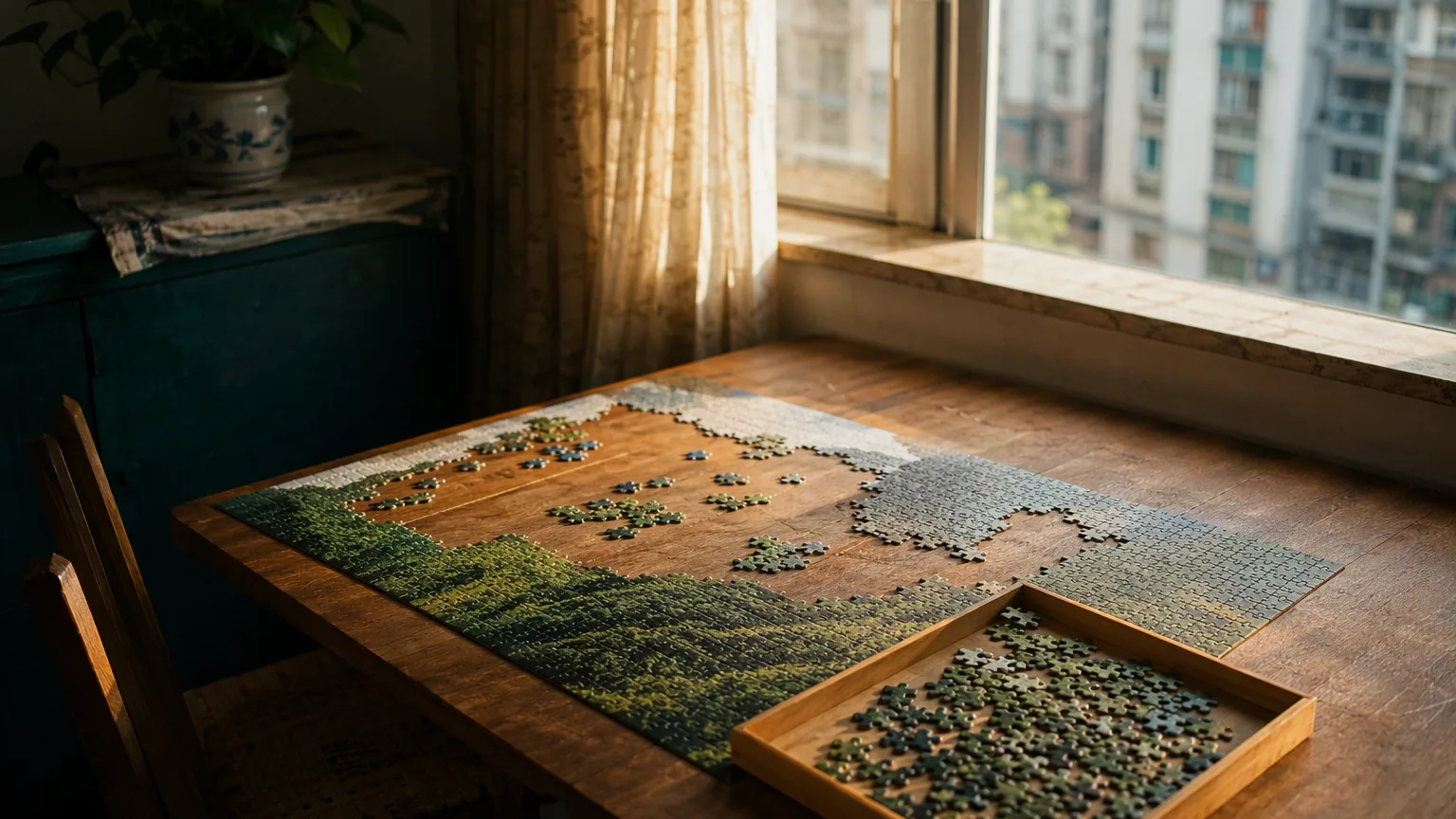
A jigsaw puzzle suits an older adult at 35 to 100 large pieces: enough to fill an afternoon, few enough to finish. Work on a board with a raised edge that slides under a sofa, keep the box lid propped where the picture is visible, and sort pieces into shallow trays before starting.
Why a jigsaw suits an afternoon with no plan
A jigsaw has no rules, no opponent and no score, which is exactly why it survives where a game does not. Nobody has to be taught anything, nobody can lose, and the work can stop in the middle without a word being said about it.
It also answers a specific problem that a tablet cannot: a person who wants to be occupied for an hour without being talked to. That is a real preference and not a lesser one. Some people want company with a task, and some want a task that happens to be in the same room as somebody else.
What a puzzle does need is a place to live. A half-finished jigsaw on a dining table is a jigsaw that gets cleared away in a temper at teatime, and a puzzle that has to be rebuilt every day is a puzzle that stops being started.
Choosing the piece count and the picture
Piece count is the only setting a jigsaw has, so it is worth getting right on the first purchase. The useful range for most older adults is 35 to 100 pieces in a large-piece cut, which is enough work to fill a session and few enough to finish in one. A 500 piece puzzle bought as a challenge usually becomes a box in a cupboard.
The picture matters as much as the count. Large areas of one colour are hardest, because there is nothing to match on; a busy scene with clear objects, windows and people is easier to sort and easier to talk about. A photograph of a place the person knows is better than an abstract, because the conversation is free.
| Pieces | Typical time | Suits | If it is too hard |
|---|---|---|---|
| 12 to 24, large piece | Twenty to forty minutes | A first attempt, low vision, or a shared table with a child | Nothing to fix, this is the floor |
| 35 to 50, large piece | One sitting of an hour | Most older adults, done alone or in a pair | Sort by colour into four trays before starting |
| 100, large piece | Two or three sessions | Someone who has always done puzzles | Leave it out on a board between sessions |
| 200 to 500 | A week or more | An experienced puzzler with good light and a spare table | Build the frame first, then one object at a time |
| 1000 and above | Weeks | Rarely the right purchase for a first puzzle | Keep the box for a visitor who wants a project |
Setting up a puzzle that can stay out
The setup is the difference between a puzzle that runs for a week and one that is packed away on the first evening. None of it is expensive.
- Use a puzzle board with a raised edge, or a stiff board with a strip of wood along two sides. Pieces that slide off the edge end up on the floor, which is a trip hazard as well as a nuisance.
- Choose a board that fits under a sofa or behind a door, so the puzzle can be lifted away whole when the room is needed for something else.
- Light the board from the side or above. A lamp behind the person puts their own shadow across the pieces.
- Sort before starting: edges in one tray, distinct colours in others, the rest in a third. Ten minutes of sorting saves an hour of hunting.
- Prop the box lid where the picture is visible, or photocopy the picture at a larger size. A picture on the bottom of a box is no use to anybody.
- Put a cloth over the board when it is not in use, so pieces are not lost to a sleeve, a cat or a cup of tea.
When the puzzle is too hard, or the eyes are the problem
Almost every puzzle that fails is failing on sorting rather than on fitting. If the person is hunting for pieces rather than placing them, the answer is fewer pieces and pre-sorted trays, not encouragement. A puzzle with 35 pieces arranged in four trays is easier than a puzzle with 50 pieces in one heap, even though it says less on the box.
Eyesight is solved by contrast and size rather than by sitting closer. A light-coloured board under a dark picture, a lamp with the light coming over the shoulder, and a magnifier on a stand all help. If the person has stopped talking about the picture, they may not be seeing it clearly enough to comment.
Weak hands and tremor are helped by thicker pieces and by building on a surface with a lip, so a piece can be nudged into place rather than pressed. If the joints are painful, a puzzle is a bad afternoon and hand exercises for seniors is a better use of ten minutes first.
The signal to stop is the same as anywhere else. If the puzzle has become something to be got through, or the person is apologising for the pieces they cannot place, put it away and say when it will come out again. Nothing about a puzzle is worth an afternoon of somebody feeling slow.
A table puzzle, a browser puzzle and the app
Most searches for jigsaw puzzles for seniors are looking for free puzzles to play on a screen, which is a different activity with different advantages. A browser puzzle never loses a piece, needs no table and can be made easier with one click; it also has no weight in the hand, no room for two people to work side by side, and nothing to show at the end. Both are worth having, on different days, and a family should be clear about which one they are buying.
The same honesty applies to what any of it does. A puzzle gives an hour of focus, a shared task and a finished thing to look at, which is worth having for its own sake. There is no good evidence that puzzles protect thinking, and a family that expects that will be disappointed in a way that has nothing to do with the puzzle. The National Institute on Aging describes what is and is not known about keeping the mind active, without promising anything.
If the family also wants a scored practice with a weekly line, the six training games in Sanospark keep that record and are described on the home page. If the person would rather have a game with rules, board games for seniors is the shelf; if the afternoon is quiet and word-shaped, word games for seniors needs no table at all. Pieces on a floor are worth thinking about where somebody already walks with a frame, and Steadicore works on fall-like pattern detection in residential care; where the puzzle is set up in a parent home that several siblings visit, Easikin is an SI (artificial intelligence AI) caregiving app for the handover between them.
Questions families ask about jigsaw puzzles
The same five questions, with short answers.
- How many pieces should I buy first? Thirty five to fifty in a large-piece cut. Buy one, see how an afternoon goes, and buy the next size only if it was finished with time to spare.
- Should the puzzle be done together or alone? Ask. Some people want the company, and some want an hour where nobody is watching how they do it.
- What do we do with a finished puzzle? Photograph it, then either frame it or break it up together. Leaving it on the board for a week is also fine, and it gives visitors something to talk about.
- Is a puzzle good for the brain? It is good for an afternoon. Claims that puzzles protect memory are not supported, and a puzzle is worth doing for the hour rather than for a promise.
- What about an online jigsaw? Good if the person enjoys a screen and there is no table free. It loses the two things that make a table puzzle social: the shared board and the piece in the hand.
The weekly Sanospark practice
Next week, one exercise you can do straight away
One email a week: a printable five-minute brain exercise and a note for whoever is doing the caring. No app, no phone number.
Just an email address. Stop any time; we never pass it on.
Explore more
- table games when a puzzle is too solitary — the shelf a puzzle sits on
- a short hand routine before the pieces come out — for stiff fingers and a weak grip
- filling the rest of the day at home — a puzzle is one hour of a long week
- what Sanospark is and what it is not — the six games, the report, the honest line