Physical training
Resistance Training for Seniors: How to Start
Sanospark · · 9 min read
Resistance training for seniors works the same way as resistance training for older adults anywhere: a load heavy enough to matter, two or three times a week, a little harder every few weeks. It needs no gym — standing up from a chair without using your hands is a leg press with your own body weight. If there is pain, a heart condition or a recent fall, ask a doctor or physiotherapist before starting.
What strength training is for an older adult
Strength training for older adults means working the muscles against resistance, and the guidance is plainer than most people expect: at least two days a week, on the major muscle groups, hard enough that a short rest is needed. It is a separate job from walking, and it needs no gym.
Walking raises the heart rate and works the lungs; that is aerobic work and it is valuable on its own. Strength training is the other half: it asks the muscles to push or pull against something, and the body answers by keeping more of the muscle it has. The two do different jobs, and neither covers for the other.
The point is not appearance. Muscle that is asked to work hard stays able to do the ordinary things an older person does every day: stand up from a low chair, carry a bag of shopping, steady a step on the stairs. Those are the tasks strength training quietly preserves.
How much and how often to train
The NHS guidance for adults aged 65 and over is the clearest starting point: do activities that improve strength, balance and flexibility on at least 2 days a week. At least is the word to notice. Two days is the floor, not the ceiling, and the benefit comes from doing it regularly rather than in one heavy burst.
The dose inside a session is just as simple, and the NHS states it directly: work the muscle to the point where you need a short rest before repeating it. That is the honest test of whether the load was heavy enough. A movement repeated thirty times without tiring is not loading the muscle much; one that needs a pause after eight or twelve is.
Rest between sessions matters as much as the sessions. Muscle strengthens in the recovery afterwards, not during the effort, so two days back to back are worth less than the same two days with a gap between them. A workable week is strength on two non-consecutive days, with walking or rest on the others.
What counts as muscle-strengthening activity
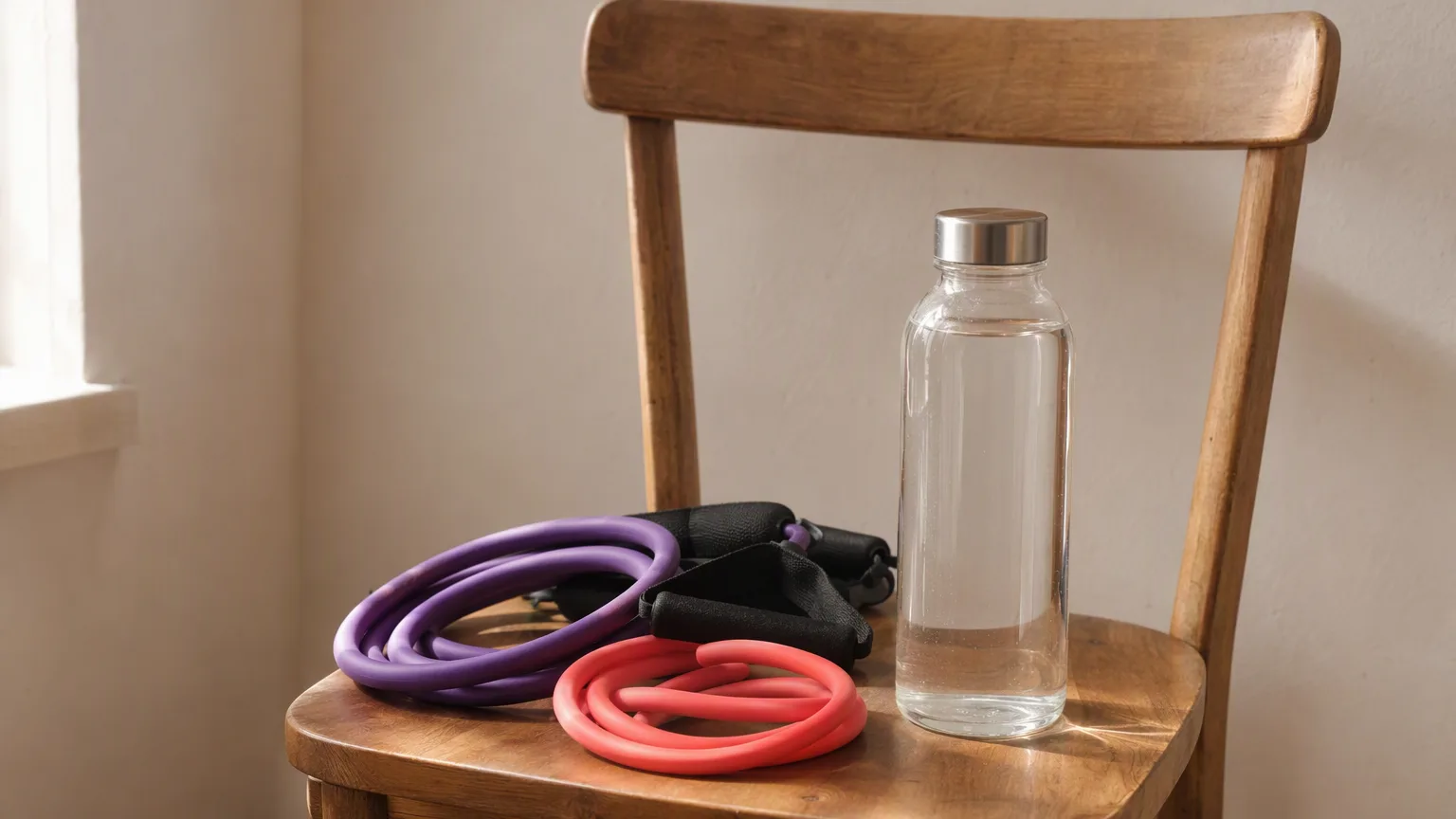
The same NHS page lists what counts, and the list is more ordinary than a gym brochure: lifting weights, working with resistance bands, exercises that use your own body weight such as push-ups and sit-ups, carrying heavy shopping bags, and heavy gardening such as digging and shovelling. Yoga, pilates and tai chi sit on the same list. The thread is resistance, something pushing back against the muscle.
No equipment is required. The cheapest resistances are the body itself, a chair, a wall and a couple of full bottles or bags. What matters is that the muscle works hard, not that the equipment looks serious. A wall push-up done slowly to the point of a short rest is a strength exercise; a light weight waved about is not.
- Your own body weight: standing up from a firm chair without using the arms, a wall push-up, a slow step-up onto a low stair.
- A resistance band, which adds load to a pull or a press for a small cost and stores away flat.
- Household loads: a full shopping bag carried one-handed, a filled bottle raised and lowered.
- Heavy gardening, where digging and shovelling do the same job a gym would.
How to start at home with no equipment
Begin with two short sessions a week and one or two movements, not a whole programme. A common first pair is the sit-to-stand, rising from a firm chair without using the arms, and the wall push-up, standing a step back from a wall and pressing away. Both use only the body and a chair, and both load the legs and arms through a range the person already has.
The NHS adds one caution before any of this: speak to a GP first if you have not exercised for some time, or if you have a medical condition or concern. Pain is a stop signal, not a target, and a movement done slowly and under control is worth more than one rushed to finish sooner. If standing is the hard part, chair exercises for seniors start from the same seated position.
The World Health Organization is explicit on the same point: any amount of physical activity is better than none, and muscle strengthening benefits everyone. That matters on the bad days. A session scaled down to one wall push-up still holds the habit, and the habit is the whole point.
Why walking alone is not enough
Walking is the most recommended activity there is, and it does a great deal, but it is aerobic work: it challenges the heart and lungs more than the muscles. Muscle that is never asked to work hard still gets smaller and weaker with age, however many steps are walked, because the body keeps only the muscle it is asked to use.
The NHS makes the split plain: muscle-strengthening exercises are not always an aerobic activity, so they are needed in addition to the 150 minutes of moderate activity a week. A person who walks every day and never lifts anything heavy is doing one of the two jobs well and the other not at all.
Strength and balance are also where the fall question lives. The NHS notes that if you have fallen or are worried about falling, exercises that improve strength, balance and flexibility help make you stronger and more confident on your feet. That is the mechanism, not a guarantee: no exercise removes all risk, and anyone with a history of falls should raise it with a clinician. A family worried about falls in a care setting is asking a different question again, and the parent company, SilverGuard, works on residential-care sensing and risk prediction, which is that separate problem.
Pairing strength work with brain training
A strength move can carry a thinking task at the same time. Standing up from a chair while naming the days of the week backwards, or holding a band pull while counting colours on a card, asks the body and the brain to work at once. The research term is dual-task training, and the post on dual-task training sets out why combining a movement with a mental demand is different from doing either alone.
That is also the shape of the six camera-based training games from Sanospark, played on a tablet the family may already own, with the hands in the air and no extra hardware. Some rounds ask for a movement and a decision together, which is the same combination in a form a family can run without a physiotherapist.
Keep it ordinary. A strength routine that happens twice a week and a brain session that happens most days sit side by side, and the weekly family report keeps both in one place so nobody has to hold a spreadsheet. If a session starts to feel like a test, scale it back; the point is the doing, not the score.
The weekly Sanospark practice
Next week, one exercise you can do straight away
One email a week: a printable five-minute brain exercise and a note for whoever is doing the caring. No app, no phone number.
Just an email address. Stop any time; we never pass it on.
Explore more
- the six camera-based training games — short rounds played with the hands in the air, no extra hardware
- the weekly family report — strength and brain sessions counted in one place
- dual-task training for older adults — why a movement and a thinking task are trained together
- chair exercises for seniors — the seated start when standing is the hard part
- residential-care sensing and risk prediction — the parent company, working on a separate problem
- the caregiving app for adult children — day-to-day coordination around one parent