Physical training
Fall Prevention Exercises for Seniors: An 8-Week Plan
Sanospark · · 9 min read
Fall prevention exercises for seniors work by training balance itself: standing on one leg, turning the head while walking, narrowing the stance, and doing it without holding on. Strength supports it. Two sessions a week is the floor, eight weeks is the shortest honest test, and a dated note of what was done is what makes progress visible.
Why fall prevention is balance training, not a walking habit
The Hong Kong Department of Health Elderly Health Service reports that of more than 35,000 community-dwelling people aged 65 and over surveyed in 2023, 15.7% had fallen at least once in the previous year, and about 9.8% of those who fell had broken a bone. That is roughly one in six people in a year, and it is the figure that makes this worth an hour a week.
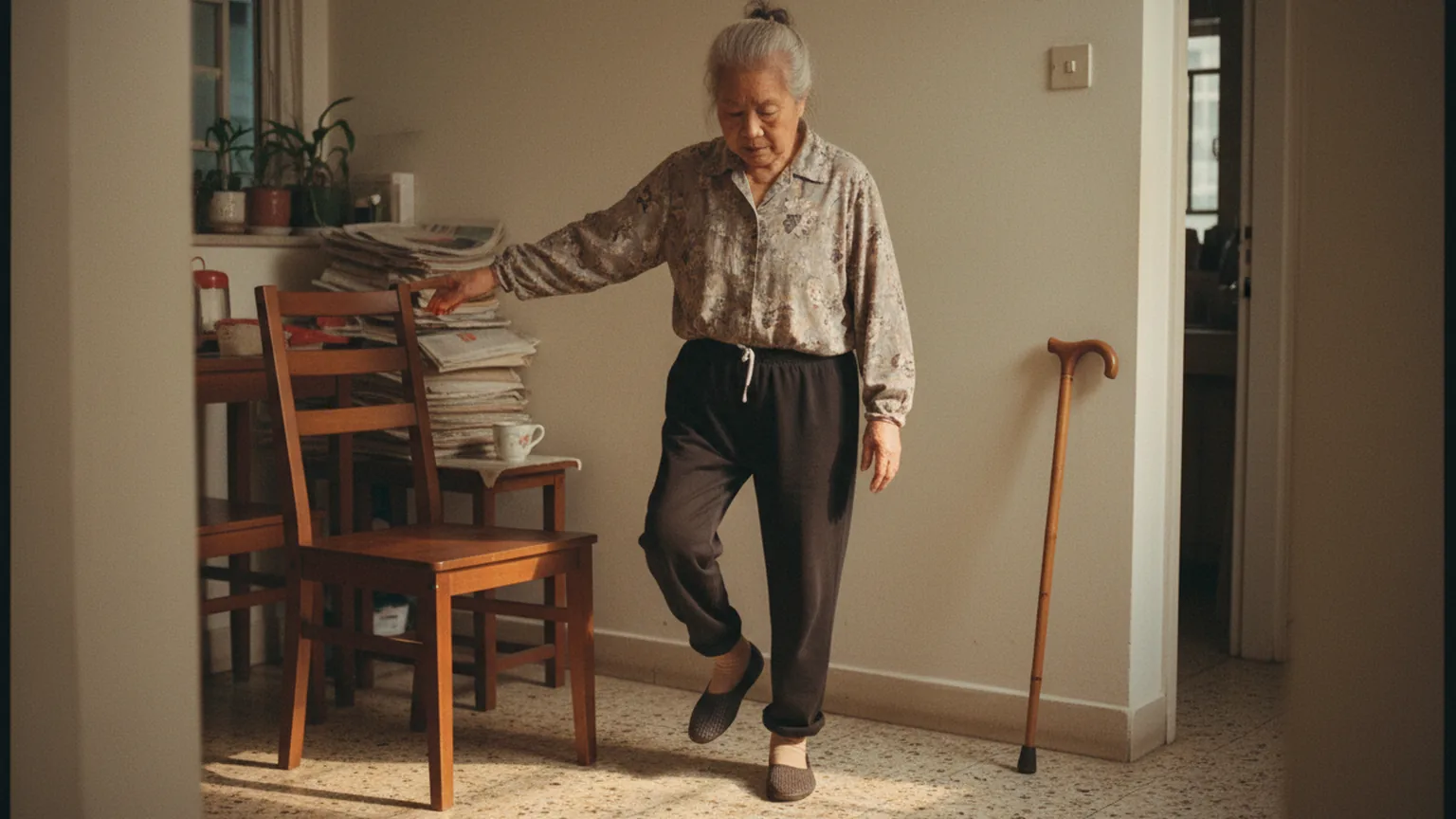
Walking on a flat corridor barely tests balance at all. Balance is a skill the body keeps by being asked to recover: a step that lands slightly off, a turn made while the head is moving, a sock put on while standing on one leg. When none of that is asked for, the skill narrows to the width of the corridor it is used in, and the first unusual surface is the one that finds the edge.
Three inputs feed it, and each one can be trained on its own. The eyes report where the body is in the room. The inner ear reports which way is up. Pressure sensors in the feet and ankles report how the weight is moving. Take away any one of those and the other two have to work harder — which is exactly why closing the eyes, or turning the head, turns an easy exercise into a balance exercise.
Strength and balance are related but they are not the same job, and one does not cover for the other. Strength is what lets the legs take a step at all; balance is what keeps the body over its feet while it happens. This page is about the second one. The load work is on its own page, and strength training for older adults is where to read it.
One caution belongs at the top rather than at the bottom. Training lowers risk; it does not remove it. Anyone who has fallen in the last year, feels dizzy on standing, has Parkinson's disease, has had a stroke, or is on several medicines should have a doctor or physiotherapist set the level before starting a programme from a web page.
What the official guidance actually asks for
Both of the sources this page relies on agree on the ingredients and are vague on the order. The NHS guidance for adults aged 65 and over asks for activities that improve strength, balance and flexibility on at least 2 days a week, alongside 150 minutes of moderate activity — and it adds a sentence that matters here: if you have fallen or are worried about falling, exercises to improve strength, balance and flexibility help make you stronger and more confident on your feet.
The Hong Kong Department of Health takes the same view from the other end. Its fall-prevention advice is that falls are preventable but need several things at once, and that older adults should regularly do physical activity that strengthens muscles and improves flexibility, coordination, cardiorespiratory fitness and balance — naming tai chi as one example. Its environment list is equally specific: clear the floor, keep it dry, do not walk indoors in socks only, choose a firm chair at the right height, add a night light.
Neither document tells you what to do in week one and what to add in week five. That order is what the rest of this page supplies. It is assembled from their principles, not copied from the protocol of a published trial, and no reduction in falls is claimed for it.
| Source | What it asks for | Stated dose | What it leaves open |
|---|---|---|---|
| NHS, adults 65 and over | Activity that improves strength, balance and flexibility, plus 150 minutes of moderate activity | At least 2 days a week | Which balance moves, in what order, and how to tell it is working |
| Hong Kong Department of Health, Elderly Health Service | Regular activity for strength, flexibility, coordination, heart and lungs, and balance, such as tai chi, alongside home-safety changes | Regularly, with no number given | A starting point, an eight-week order, and a record |
| This page | Four balance dials tightened one at a time, two sessions a week, seated entry from a chair | Two sessions a week, eight weeks | Nothing clinical: a physiotherapist still sets the level after a fall |
The eight-week plan, one page
Two sessions a week, twenty minutes each, with a rest day between them. Every level is done beside a kitchen counter or the back of a firm dining chair, and the counter is there to be touched, not gripped. That distinction is the whole progression: two hands, then one hand, then fingertips, then nothing.
Weeks one and two are the floor, and most people can start here today. Stand facing the counter with both hands on it, feet together, and hold for thirty seconds; do that three times. Then sit down and stand up from a firm chair without using the arms, eight to ten times. That is the session. It looks too easy, and for the first fortnight it should.
Weeks three and four take one hand off the counter and place the feet heel-to-instep, one foot half a step in front of the other, holding thirty seconds on each side. Weeks five and six go to fingertips on the counter and heel-to-toe, and add a slow head turn to each side while standing still. Weeks seven and eight take the hands away entirely, add five seconds with the eyes closed only while someone else is in the room, and add ten steps of heel walking along the counter.
The rule that keeps it safe is the same at every level: a firm chair behind the knees, and never a movement taken to the point of a stumble. The right effort is the last five seconds being work. If a level is survived rather than done, it is too high, and dropping back a level for a fortnight costs nothing.
| Weeks | What you add | Hands | The end-of-fortnight test |
|---|---|---|---|
| 1 to 2 | Feet together beside the counter, thirty seconds three times; sit-to-stand from a firm chair, eight to ten | Two on the counter | Thirty seconds with the feet together, twice, without a wobble that needs a grab |
| 3 to 4 | Heel-to-instep stance, thirty seconds each side; the same sit-to-stand, slower down | One on the counter | Thirty seconds heel-to-instep on each side, one hand only |
| 5 to 6 | Heel-to-toe stance, and a slow head turn to each side while standing still | Fingertips | Heel-to-toe for twenty seconds, and a full head turn each way without stepping |
| 7 to 8 | Hands off, five seconds eyes closed with someone present, ten steps of heel walking | None | Five seconds eyes closed with a person in the room, and ten heel steps down the counter |
How to make a balance move harder without buying anything
There are four dials, and only one of them is turned at a time. Moving two at once is how a session stops being training and becomes a test of nerve.
The first dial is the base: the feet. Feet apart is easiest, feet together is harder, heel-to-instep harder again, heel-to-toe hardest. The second is the hands: two on a counter, then one, then fingertips, then nothing. The third is the head and eyes: still, then turning, then closed. The fourth is a second task — counting backwards from twenty, naming the days of the week in reverse, carrying a light object from the counter to the table and back.
The floor and the shoes are part of the exercise, not background. The Department of Health advises against walking indoors in socks only, and against loose rugs, wet floors and clutter in the walking line; a flat, non-slip shoe on a dry, clear floor is the condition the whole programme assumes. A session done in slippers on a polished floor trains something different from what this page describes.
Stop signals are not negotiable. Dizziness, chest pain, a new joint pain, or the same move producing a near-fall twice means stop the session, step back a level next time, and raise it with a doctor or physiotherapist. A near-fall is information, not a setback to push through.
- Base: feet apart, then together, then heel-to-instep, then heel-to-toe.
- Hands: two, then one, then fingertips, then none — and the counter stays in front of you at every level.
- Head and eyes: still, then a slow turn each way, then closed for a few seconds with someone else present.
- Second task: count backwards, name the days in reverse, or carry something light while walking the length of the counter.
Recording it so the record says something
A session that is not written down cannot be progressed, because nobody can tell whether the same thirty seconds was done with two hands three weeks ago or with none. The record does not need to be an app. A sheet of paper on the fridge, one line per session, is enough — and for many older adults in Hong Kong it is the only version that gets used.
Four fields carry the whole thing: the date, the move, the seconds or repetitions, and how many hands were used. A fifth is optional and worth having: how confident the person felt, scored one to five. That number is the one that catches the thing the seconds miss, which is a person who can hold the stance but no longer trusts themselves to.
Read the record for one thing only: whether the support went down at the same number of seconds. Two hands to one hand at thirty seconds is progress. Thirty seconds to sixty seconds with the hands unchanged is also progress, but a smaller one. A fortnight where neither moved is the signal to change a dial rather than repeat the session.
The same habit carries across to the thinking work. A dated line on a page is what turns a training session into something a family can look at together, and tracking cognitive change over time sets out the version of that record used for the cognitive sessions. Where a paid carer comes in during the week, the same line is what tells them what was done and what was not, in the form caregiver handover notes describes.
After a fall, and when to stop training
The Department of Health gives the sequence for the first minute. Stay still, breathe, and check for injury before moving anything; then move along the floor towards a wall or a firm piece of furniture and get up slowly, using it for support. If getting up is not possible, call for help — the personal emergency link if there is one, a phone, or a shout and the front door — and do not keep trying to stand.
A fall is also a reason to tell someone, even when nothing hurts. The Department of Health is direct that a fall should be reported to family and that a doctor should be seen if there is any doubt, because the injury that changes a life is often the one that was walked off on the day.
The longer damage is confidence. The same guidance notes that people who have fallen often lose faith in their own ability, stop going out, and become more isolated — which lowers activity, which lowers balance, which raises the risk again. The way out of that loop is training at a level the person will actually do, and after a fall that level should be set by a physiotherapist rather than by a web page.
That is the honest boundary of this article. It describes training that healthy older adults can run at home, built from published official guidance, and it promises no medical outcome. The monitoring side of the same problem — a care home knowing that someone has got out of bed at two in the morning — is a different job, and SilverGuard works on that one. For the training itself, the six camera-based games pair a movement with a decision, which is the same balance work with a thinking task attached.
The weekly Sanospark practice
Next week, one exercise you can do straight away
One email a week: a printable five-minute brain exercise and a note for whoever is doing the caring. No app, no phone number.
Just an email address. Stop any time; we never pass it on.
Explore more
- strength training for older adults — the load work that keeps the legs able to take the step
- chair exercises for seniors — the seated entry, for anyone starting from a chair
- tai chi for seniors — the class the Department of Health names by example
- tracking cognitive change over time — the same dated record applied to the thinking sessions
- the six training games in the app — balance work with a decision attached